Saturday, November 29, 2008

How Does Gaviscone Help

ACTIVITY 2: RUTHERFORD, the atomic nucleus

1. When you start the training of young students who may end up in scientific facts and rights, it is essential that they possess adequate teachers about both their level of knowledge as to the student's abilities. These teachers are involved, if they perform their job well, more directly in the creation of new minds andlor they may end up being one as their teachers. However, having studied under someone whose experience has been too much practice, our knowledge can not reach required. The same is true if your teacher is someone who does not provide us with expertise, limited to only a theoretical instruction, although correct, differs greatly than expected outside the walls of an institution.
therefore can be either someone who teach us are highly qualified in the theoretical or practical, two flaws in science learning:
could occur if the teacher is well versed in books and whose knowledge of subject matter taught are purely theoretical, we end up knowing the same as this person knows, but not knowing what to do in real situations. This problem is now facing a number of students in science subjects where teachers contribute a practical learning, the "hands-on" by native speakers.
However, it is better to the opposite side of the coin, some quite practical knowledge, not theoretical wisdom or the "why" of the results of our actions, is also potentially disastrous.
When the teacher is a combination of both, it reaches a state of perfection, in which what the student will learn best practice and theory.
is why what was considered normal (experts, researchers, teaching in universities) and which today has virtually lost completely, it should be recovered as a routine method of teaching. Probably that way, you could reach that state of "perfection" above.

2. differences between physics and chemistry.
First, we classify and define exactly what is Physics, Chemistry, and what, and why they are so often grouped.
Both are studies of the changes that matter get. However, the physics are those changes do not alter the nature of this matter, but change its form, status or appearance. Is this the reason for that is called "Physics", since these changes affect the physical form of matter, to your appearance. For example, take the already well-known example of change in the water. The water, when passing liquid, solid or gas, takes a different look, but still water, H2O. The molecules that compose it have not changed.
Chemistry, for his part, considering those changes that do alter the nature of matter. That is, those where the structure and composition of the matter is changed, and new products are formed from very different substances. When matter changes in this way, the changes it undergoes can reach the atomic level, although this is not the reason for our speech. An example of chemical change would be the combustion of a wood dowel, leaving what was once reduced to ash wood. This is a combustion.
Let us see once well defined and clarified their definitions, exactly what distinguishes them. Based
, we have already mentioned the main difference: the level at which the changes affect one and another place in the area. The properties of an element or compound to be studied by physical methods, not change. If the methods we use are chemicals, they will. Rutherford

felt, over his career, that "all knowledge; or physically, or is stamp collecting. "This, as is quite obvious, does not mean anything other than Rutherford took physics as kingpin of science, which revolves around any other scientific method. Others might say it , putting all the math in place of physics, and probably would hold this statement. Here's a xkcd.com comic strip, which is reflected precisely this situation taken to its logical extreme.


Despite this belief of his, ended up getting the Nobel prize, not physics, but chemistry, and the words spoken to get were: "I have changed many times in my life, but never so sharp as in the physical metamorphosis of a chemical." This was because their research mainly focused on the decay of radioactive elements and their transformation into other elements that, according to the above definition, is not nothing but a chemical change.

3. Photo: Tesla at age 40.
Nikola Tesla was born on July 10, 1856 and died on January 7, 1943. He was an inventor and a mechanical and electrical engineer. Tesla is often described as a scientist and inventor of the age modern, a man who is said to shed light on the earth. It is known especially for his many revolutionary contributions in the field of electricity and magnetism, in the years between the nineteenth and twentieth centuries. Tesla's patents and theoretical work formed the basis of modern alternating current, including alternating current motor and electrical distribution systems. They helped with the Second Industrial Revolution. His contemporaries cited as the "patron saint of modern electricity."
After his demonstration of wireless communication (radio) in 1894, and after winning the "War of Electricity", became one of the largest U.S. electrical engineers. During this period of his life, Tesla's fame rivaled that of any other inventor or scientist in history or popular culture, but due to his eccentric personality and his seemingly unbelievable and sometimes bizarre claims about possible scientific and technological developments, Tesla ended up being "marginalized" and seen by society as a "mad scientist." Never failing to put much interest in his finances, Tesla died bankrupt at the age of 86.
international system unit of measurement of magnetic flux density tesla was named in his honor. Tesla Effect is observed in the filaments of light bulbs for energy transmission.
Apart from his work on electromagnetism and electromechanical engineering, Tesla has contributed to the establishment of robotics, remote control, radar and computer science, as well as the expansion of ballistics, nuclear physics and theoretical physics.
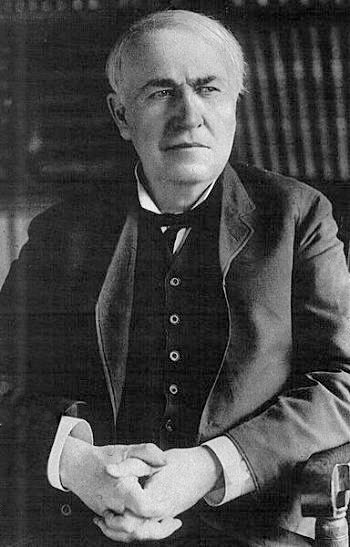
Photo: Thomas A. Edison.
In 1884, Tesla arrived in New York, with just nothing but a letter of recommendation from Charles Batchelor, his former boss. In the letter of recommendation that he gave Thomas Edison, Batchelor had written: "I know two great men and you're one of them, the other, this young man." Edison hired Tesla to work, at first with simple electrical engineering and quickly progressed to solving the most complicated of your company. Was given the task of making a complete redesign of the current generators of the Edison company.
said Tesla was offered the equivalent of $ 1.1 million to redesign existing inefficient motors and generators of Edison, which would be an improvement both in service and economy. Tesla worked day and night to redesign and got great benefits for Edison in the process. During 1885, when Tesla claimed his money, Edison replied, "Tesla, you do not understand our American humor," and withdrew its promise. So, Tesla had a salary of $ 18 per week and should have worked 53 years to win the same amount, equivalent to the initial capital Edison. Tesla resigned when he was denied an increase of $ 25 per week. Tesla
later find work for other companies, while Edison would not want to hear about the multi-phase alternating current designs that Tesla had proposed, and believe that the direct current electricity was the future.

Photo: Guglielmo Marconi.
In 1904, Tesla competed with Guglielmo Marconi's patent for the invention of radio. However, the U.S. patent office gave Marconi the patent.
Since the Nobel Prize in Physics was awarded to Marconi for radio in 1909, Edison and Tesla were mentioned as potential for a shared Nobel prize in 1915, which led to much controversy. Because of their enmity, despite their enormous scientific contributions, and both sought to minimize the other and their rights to win the award, both refused to ever accept the Nobel if the other received it first, and any possibility of sharing the prize.

4.
4a) What is the difference fluorescence of phosphorescence?
are different kinds of luminescence. Fluorescence is a property of fluorescent minerals that emit a bluish light when stimulated by external radiation, the phosphorescence of the phosphorescent property, which emit greenish light that remains visible even when the light source (normal light) is not present. As the name suggests, the elements fluorine-fluorescent, and phosphorescent phosphor.

4b) What are X-rays? How do you find?
X-rays are a form of electromagnetic radiation with a wavelength shorter than UV rays emanating from yfueron discovered when Crookes tubes, which were experimental discharge tubes invented in the late XIX, by scientists investigating cathode rays (beams of energetic electrons created in these tubes). Crookes tubes electrons created by ionization of residual air from the tube to an electric shock that accelerates electrons to a speed sufficient to create X-rays when they hit the tube anode.

In the picture the first printing X-rays: the hand of a woman with finger rings.

4c) What is radioactivity? How was it discovered?
is the process by which an unstable atomic nucleus loses energy by emitting ionizing particles and radiation. This energy loss results in an atom of a class becomes a different class.
was discovered in 1896 by scientist Henri Becquerel while working on phosphorescent materials. These materials, which glow in the dark after exposure to light, made him think that the glow produced in cathode ray tubes for X-rays might be connected with phosphorescence. He wrapped a photographic plate in black paper and placed various phosphorescent minerals on it. All results were negative until he used uranium salts. The result with them was an intense darkening of the plate, it soon became obvious that this blackout had nothing to do with phosphorescence because the plate is obscured when the mineral was in the dark. The phosphorescent salts of uranium and metallic uranium also blackened the plate. Clearly, a form of radiation passing through the paper and caused the blackout.

4d) Why were important the contributions of the Curie and Becquerel Rutherford?
At first it seemed that the new radiation was similar to the recently discovered X-rays A further research by Becquerel, the Curies, Rutherford and others found that radioactivity was significantly more complex. Different types of energy loss could occur, but Rutherford was the first to realize that all happened according to the same mathematical formyl.
also found that many other elements besides uranium have radioactive isotopes. A systematic search of the total radioactivity in uranium led to Marie Curie to isolate a new element, polonium, and to separate the other, the radio, barium. The chemical similarity between the latter two would have been difficult to distinguish, except for radioactivity.

4e) What are alpha, beta and gamma ? Sort them energetically.
The alpha particle is the heaviest of the three. Alpha and beta radiation are not waves, but highly energetic particles ejected from an unstable nucleus. In the case of alpha radiation is a helium atom contains 2 neutrons and 2 protons. Leaves the nucleus of an unstable atom to one-tenth the speed of light. Particles These are relatively large and heavy, so that alpha rays are very penetrating and are easily absorbed. A sheet of paper or a layer of air 3 cm thick stops them.
Beta rays are much lighter. The beta particle is an electron energy fired by the nucleus of an unstable isotope to restore energy balance. Leave the nucleus at a speed of 270,000 km per second. They can be stopped, for example, aluminum foil of a few millimeters thick or 3 meters of air.
gamma rays are of very high energy. Is a photon or light wave the same electromagnetic family that light and X rays, but much more energetic and harmful. Is capable of damaging living cells to decelerate by transferring its energy to the surrounding cellular components.
This image compares the energy power of radiation.

4f) What is the law of atomic decay? Why is used as a method of geological dating?
atomic decay law determines the rate at which radioactive elements decay. Used as a method of geological dating because their average life is highly variable, and the law of atomic disintegration can predict the rate of decay for later measurement.
Carbon-14, also known as radiocarbon, is an isotope of carbon. It has 8 protons and 6 neutrons, in contrast to the 6 and 6 which has the current carbon (carbon-12). Its presence in organic materials is the basis of dating used today to set a date for archeological, geological and hydrogeological. Radiocarbon dating is a method that is used to determine the age of materials up to 60,000 years old. Willard Libby felt that the radioactivity of carbon-14 would be about 14 disintegrations per minute per gram. One of the most common uses of this technique for dating archaeological organic remnants. Plants adapt atmospheric carbon during photosynthesis, so the level of radiocarbon in plants and animals when they die is similar to the atmosphere at that time. However, decreases from then on by a loss of energy (radioactivity), allowing to estimate the date of death.

4g) What is a Geiger counter?
A Geiger counter, also called Geiger-Müller counter, is a type of particle detector that measures ionizing radiation. Geiger counters are used to detect radiation especially gamma and beta radiation, but certain models can also detect alpha radiation. The sensor is a gas-filled tube (usually helium, neon or argon with halogens added) that briefly conducts electricity when a particle or photon of radiation temporarily makes the gas conductive. The tube amplifies this conduction by a domino effect and emits a pulse of current. A variation of the Geiger tube is used to measure neutrons, creating an alpha particle inside the detector so that they can count.

5. Rutherford alpha particle beam experiment. these fine jets were obtained simply by placing a strong radioactive source inside Lead a closed box, but with a small opening. Through it out the small particles. the foreground used to having an impact beams was mica. As the particles passed knew undaunted by the thin layer of mineral, also noted that as the particles put more blades became more diffuse until it reached a thickness in which all were absorbed. Mica has not worked because the probability of their unstressed collide with the beam was very small. They laid out a semi-circular screen of zinc sulfate behind the gold foil on which the alpha particles fired. The flashes at angles more than 90 degrees, or alpha particles that bounced, would be observed under the microscope. 1 in 8,000 was fired alpha particles by gold back. When repeated with platinum the result was the same. We imagine it's because the atoms are more compact than the mica. Commentary
sentence: "It's like a rocket ship shot of good quality on a sheet of paper and bounce."


Well we wanted a comparison between experiment and the sentence of a military nature. The naval shell refers to the alpha particle beam and the sheet of paper in gold foil. Use the naval shell because it is a very powerful weapon as alpha particles, and compared it to scale, like a sheet of paper that a sheet of ice cold gold.


this explanation to help you put a video:


and a simulator (put it this way because we could not embed it as it's a blog).


6. The atom was composed of a nucleus containing protons and neutrons, and for a few orbits that electrons revolving around the nucleus. The core mass was 2,000 times higher than that of electrons. The problem, accelerating electric charge emits an electro magnetic radiation. one electron in its orbit will be subjected to accelerations. Emit radiation and therefore lose energy. In its orbit would remain split second so that atom would not be stable. The matter could not exist if it were made of atoms as well.
They are considered the fathers of the interaction nuclear because they were the first to discover or discuss the electromagnetic force, which is closely related to nuclear interactions.
The 4 fundamental interactions of nature are the gravitational, electromagnetic, strong nuclear and weak nuclear.


7.


Monday, November 17, 2008

Non-denominational Church Miami

PRACTICE 3: PRODUCTION OF GASEOUS SUBSTANCES (II)

SUMMARY:

This practice has included a series of experiments with the purpose of obtaining a number of gases (chlorine gas carbon dioxide). In theory, should have conducted a third experiment to get a third gas, but we had no time for this.

The goals we set were:

Naturally, the obtaining of different gases from reactions between certain substances that are part of the product of these reactions.

stoichiometric adjustment reactions, to be able to control and define exactly how many units of each item we will need (which only will be useful in practice when we have to measure reactions and to obtain an exact quantity of products, but we know anyway). Seat and

strengthening the concepts of products, reagents and dissolution, and these concepts work in practice.

We need the following reagents: hydrochloric acid

Manganese Dioxide Calcium Carbonate For the following products: Manganese Dichloride

Water Chlorine Gas Chloride Calcium Carbon Dioxide


procedures for the above products were not too simple, especially in the case of the second reaction. Luckily, we did not have to make or assemble the installation for this experiment (because the teacher already had installed). However, the first experiment, only in applying the reagent to the product. Despite the relative risks involved working with acids, it was not complicated.

As in the previous practice it, we kept a record of what happened, both on paper and on video. Videos appearing in practice are those recorded in the laboratory.


INTRODUCTION:


Our experiment has had, even before they exist, with suitable conditions to be carried out, since much of it has been effected by the teacher has made the second experiment, using methyl orange as a pH meter to show results.

These results, while spectacular to the naked eye, they can not qualify as something unusual or new, at least for a while now. This is because, being a practice whose objectives are learn to adjust and manipulate the reactions obtained with these reactions, we can only address what is unfolding before our eyes, in our case, we know what is happening (not perfect, however), studying the events that other might seem the work of magic or simply a branch of the unknown existence.

can predict certain aspects, basic and superficial, in our experiment. With our previous knowledge of organic chemistry, we have the opportunity to know what will happen. Yes, it's simple: the product of a neutral base (MnO2) and strong acid (HCl) is not in any way, completely neutral, but slightly less acid the reagent. Anyway, this is almost the most we can hope to know before you actually put "into practice" these reactions. To really know what will happen, but there is no other experience with our own hands (well, covered with gloves, at least).


EXPERIMENTAL WORK:


In this practice we have had to put latex gloves and a gown (like a real surgeons), to protect against acid. The first thing we did upon arrival at the laboratory, was listening to the explanations our teacher, Angel gave us. And then, as we normally do, get the material we needed, that this practice is: -3

test tubes.
-pipette.
-rack.
-chemical reagents indicated.
-flask.
-plastic tube.
-perforated cap test tube.
-Matches. Viewing

materials seems a simple practice, but is very complex.


To obtain chlorine gas:


After preparing all started with the production of chlorine gas: For this practice, we use manganese dioxide and hydrochloric acid. First pour a small amount of hydrochloric acid and then add the manganese dioxide, obtained by collecting manganese dichloride, water and chlorine gas. By bringing together both compounds produced an effervescence, which lasted until the end of the class. It had a greenish color as black and was in a state such as powder dissolved. The odor given off was very strong and irritating, I, Cristina, without realizing the reaction smelled almost directly, and the feeling is indescribable, you start to cough as you nose itches.


To produce carbon dioxide:


This experiment was conducted by the professor at his desk because there was not enough material for everyone. For this experiment has been used:

-
a volumetric flask with water, a container-

a test tube, a cork-boring
a glass tube and plastic one-match


On compounds we used:
calcium carbonate and hydrochloric acid, which together lead to the calcium chloride, carbon dioxide and water.
You start by filling a flask with water and covering it with his finger, he turns to leave in the pan of water upside down. After a montage is a normal flask, cork drilling glass tube with plastic and a bracket with nuts. An amount of hydrochloric acid and then calcium carbonate.
First we did a lot of calcite. When you merge the two compounds is a reaction in which the gas (carbon dioxide), which runs through the tube to the flask.


RESULTS:


OBTAINING CHLORINE GAS

We used a test tube.
As you see in the video is put as a greenish black color, and there is an excitement that lasted until the class ended, he went from a liquid to one, how shall I say ... seemed to me like dust. And the smell was very strong. I recommend you do not smell it directly. And I think these are all details that you can not appreciate having our now classic videos. In the video below is the measurement of pH of the reaction.


OBTAINING CARBON DIOXIDE

As we have said before this experiment was carried out by the teacher, and that there was insufficient material. Fill a container (something dirty ours, by the way) with water and methyl orange is like paper but liquid pH meter. As we have seen in the video turns red because the liquid is very acidic, it was found that carbon dioxide to putting a lit match into the flask, as we turned off which means CO2 actually was. I think I've told all the details not seen with this video. In the following we see the orange reaction Methyl when mixed with CO2 and how the match goes to enter the vessel containing CO2, respectively.


BIBLIOGRAPHY:
For
experimental work and the results have not been required to consult us anything but our videos, our memories and of course we have taken notes in class throughout the process.


ACKNOWLEDGEMENTS


the moment we continue with our classic to thank the teacher and if we hurry, the companies supplying laboratory equipment to school.


QUESTIONS:

1.

a) MnO2 + HCl (aq) --- > MnCl2 + H2O + Cl2 / adjusted / 4HCl MnO2 + (aq) ---> MnCl2 + 2H2O + Cl2

b) Ca2CO3 + HCl (aq) --- > CaCl2 + H2O + CO2 / adjusted / Ca2CO3 + 2HCl (aq) --- > 2CaCl2 + H2O + CO2

2. Reagents: yellow. Products: blue.

3. Yes exothermic reactions have occurred. In fact, even in the first reaction was an exothermic effect, albeit slight, to the touch felt a warmth at all bothered, if unusual, indicating that some heat was taking place there. The second reaction, Despite not being able to touch, emanating heat itself, ie the two reactions to that experience were both exothermic.

4. Chlorine Gas : Chlorine is a chemical element with atomic number 17 and symbol Cl is one of the halogen elements, found in the periodic table in group 17. As anion Cl-1, which is part of common salt (NaCl, sodium chloride) and other compounds, is abundant in nature and necessary for most life forms, including humans. In its common form element (Cl2, chlorine gas), under standard conditions is a gas a pale green color (its name comes from the Greek word for "pale green") with a density of about 2.5 times that of air. It has a distinctive odor, unpleasant and choking, which can be detected at concentrations as low as 1 parts per million, and is poisonous and toxic. Its melting point is at -101 º C, and boils at -34 ° C.

Carbon dioxide: carbon dioxide (expressed as CO2) is a chemical compound whose components are two oxygen atoms covalently bonded to one carbon atom. A standard temperature and pressure, is in a gaseous state, and exists in Earth's atmosphere in the state. He is currently on a global average concentration of about 387 parts per million volume of Earth's atmosphere. Atmospheric concentrations of carbon dioxide fluctuate slightly with the changing seasons, led by the change in volume of flora according to the seasons in the northern hemisphere. Carbon dioxide is a greenhouse gas because it transmits visible light but absorbs potently and near infrared spectrum. Although carbon dioxide mainly exists in its gaseous form, it also has a solid and liquid. It can only be solid temperatures below -78 ° C. Liquid carbon dioxide exists primarily as carbon dioxide dissolves in water. Carbon dioxide is soluble in water only when the pressure is maintained. When the pressure drops attempt to escape into the air, leaving a mass of air bubbles in the water.

5. Chlorine Gas : In nature there is in pure state as it reacts rapidly with many elements and compounds, but is part of chlorides and chlorides, especially in the form of sodium chloride in the salt mines and dissolved and suspended in seawater. Sodium chloride the common or table salt. It is used to purify drinking water by dissolving it in the same, but also has other applications as oxidants, bleach and disinfectant. Chlorine gas is very toxic (neurotoxic) and used as war gas in the First and Second World Wars.


Carbon dioxide: At room temperature (20-25 º C), carbon dioxide is an odorless, colorless, slightly acidic and non-flammable. Carbon dioxide is a molecule with molecular formula CO2. This linear molecule is formed by a carbon atom is linked to two oxygen atoms, O = C = O. As much long been used ammonia compounds and other weak acids for desencapado skins. Despite the harmful side effects they cause agents in the environment, virtually no new methods have been developed. Against this backdrop, AGA presents an alternative based on the use of carbon dioxide, which leads to multiple benefits. The polyurethane foam is present in countless products used every day by people, pulp washing with CO2.

6. Chlorine reacts with water inside and outside the body to form hydrochloric acid and hypochlorous acid, which are extremely toxic.

7. Well we have demonstrated that carbon dioxide was because we put a lighted match into the flask and went out, if oxygen would have fanned the flame.

8. We did this experiment, we can not answer the question.

Sunday, November 2, 2008

Before And After Images Of Alcoholism

PRACTICE 2: PRODUCTION OF GASEOUS SUBSTANCES

SUMMARY:

carrying out this work, our objectives fu eron, namely:

The development of basic skills in the l to Laboratory of Chemistry, in terms of safety standards to follow, the correct use of their material mininstrado and proper treatment of the products and reagents.

The practical use of our knowledge p Revios, theoretical, inorganic formulation to apply these out of paper.

The introduction of the concept of chemical reaction mica, reagents and products as well as learning the stoichiometric adjustments these reactions. It also works with the concept of dissolution.

For this we need the following reagents s (co n order to obtain the subsequent products):

Zinc (react.)

hydrochloric acid (react.):

zinc chloride (prod.):

Hydrogen (prod.):

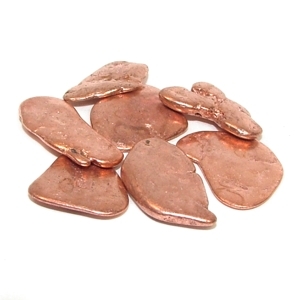
Copper (react.):

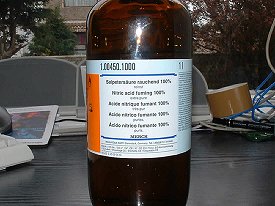
Nitric Acid (react.):

cupric sulfate (prod.):

diox. nitrogen (prod.):

Ammonium chloride (react.):

Sosa (react.):

Sodium chloride (prod.):

Ammonia (prod.)


Many of the chemicals that we were potentially dangerous to handle, so it was essential to follow exactly the teacher's instructions and never do something wild with the substances. We had to wear special clothing (robe) and goggles. The following experiment is reported not to be repeated outside a laboratory or responsible supervision.

was also necessary, as in all practices, track all that was happening before our eyes. In this case, the record was mostly done by video.


INTRODUCTION:

We are conducting an experiment that will show us apart from other things, the law of Conservation of Mass of Lavoisier. This law states that in a chemical reaction, no mass change. The dough will become, but will remain the same amount. This would need to measure, as we have done in previous years, the mass of the products and reagents, and compare them to prove they are identical.

More this is not the end of our practice. It's just one of many milestones that mark the way in this experiment, and one of the starting points for our conclusions and results.

And even with these starting points, we find it difficult to predict (in contrast to previous practice) results in the laboratory. Okay, we know that a particular reagent will give us products that we know, yes, but we are almost impossible to imagine what the outcome, current and visible in our experiment. At best, we know that the pH of a given reaction is acid or other reaction is exothermic and heat our fingers, but little further.

For real data, we need to get wet feet. We need to experiment.

EXPERIMENTAL WORK:


In this practice we have developed a series of experiments reagents, to produce chemical reactions.


chemical reactions, of which we speak, are processes in amending initial substances (reagents) in different substances (products).


Material:


  • 3 test tubes and rack


  • 1 large beaker


  • pipette


  • dropper


  • lighter


  • glass rod


  • 1 balloon


Before starting work, our teacher told us that we should protect ourselves, because we were going to handle certain substances that are dangerous. We protect gown and goggles; reminded us that we should not directly smell the substances they were going to work, but from afar. He also said that it is very important after handling chemicals we wash hands thoroughly.


For the first experiment:


Obtaining hydrogen gas, we use:


Zinc + hydrochloric acid = zinc chloride + hydrogen gas.


So much for substance, but as materials used:


1 balloon and a test tube.


started pouring hydrochloric acid into the test tube (that is discharged by the teacher). Later we put in a little piece of zinc and quickly we cover the vent with the balloon, so that the gas stays inside. Zinc contact hydrochloric acid begins as to be in a state of ferment, then the test tube gets hot by the bottom. The balloon, if it contains enough gas, rise up (like balloons). Be very careful, because if they get close a match or a lighter explodes making a loud noise and a kind of flare.


For the second experiment:

Getting
nitrogen dioxide, we used:


Copper + ac. Cupric nitrate = nitrate + carbon monoxide. Nitrogen + Water


On the materials:


1 test tube, glass rod, paper and pH meter large beaker.


NOTE: Nitric oxide, quickly oxidizes. RED IS THE GAS DI NITROGEN OXIDE.


We started by pouring a small amount of AC. oxide (the teacher), and then we added a couple of strands of copper. We saw the tube contents was green and smelled like chlorine in pools, in addition to the bottom warmed. The "gas" that existed in the walls of the tube, color was yellow. Then with a glass rod put a drop on a paper pH meter, and went red (very acidic). then pour it into a large beaker and we put water until it was neutral, its color changed to blue.


for the third experiment:


ammonia Getting


ammonium chloride + sodium = sodium chloride + Water + Ammonia


With regard to materials, we used:


1 test tube and a Bunsen burner.


started pouring into the tube a small amount of water and add a pearl of soda (to look like a pearl moth, this product is provided by the teacher). Are preparing a solution of soda, the bottom of the tube is hot.

After ammonium chloride added in small quantities, and heat the solution into the burner, always with great care, that's when the smell of ammonia invaded the school laboratory.


RESULTS


Well most of all the results have been explained in the previous section, we will sum it up in some videos that we recorded in class. But our observations we are going to put you.


Experiment 1: production of hydrogen gas


As we have seen the video, there is little to say except things that a video is not simple can perceive. For example: do not know if you have seen, but when you add zinc to hydrochloric acid, enters in a state of efesverscencia, and the back of the tube is more than hot, burning. Although we do not assure you that if you worked on the globe there is enough hydrogen balloon goes up, as they are inflated with helium. I do not know if you ever noticed what happens when you get close a match, leaving a flame can leave you without eyebrows, and a sound impressive do not know how the class next door did not come to see what happened.
Here is another video showing precisely this, and how the teacher did.


Experiment 2: production of nitrogen dioxide.


Here too there is little to say as we have the picture of the previous section (experimental work) and this video, but again do not think that you are going to get rid of the observations, because there are things that you do not you appreciate the video, like the smell, if it burns or not, etc.. And for this we are ourselves. In this experiment we can only clarify the smell, which was similar to pool chlorine, and the end of the pipe was hot. Also, if you have not seen, green the nitric acid with copper and shortly after up a kind of gas that remains on the walls, the more down, more orange and the more up, more yellowish. In this new video we measured the pH after the reaction, and mix it with water.

Experiment 3: acquisition of ammonia.


In this experiment I'm just stating the smell and tempratura. At first, the dissolution of soda did not smell anything, more like the ammonium chloride solution. But what if the tip is appreciated burned, as in previous experiments. The contents of the tube started to smell when I started to warm up.


QUESTIONS:

1.
a) Zn + HCl ---> ZnCl + H2 / adjusted / 2Zn + 2HCl ---> H2 + 2ZnCl
b) Cu + HNO3 ---> Cu (NO3) 2 + NO + H2O / adjusted / 6HNO3 2Cu + ---> 2Cu (NO3) 2 + 2NO + 3H2O + 1 / 2 O2
c) NH4Cl + NaOH - -> NaCl + NH3 + H2O (this is not needs to be adjusted)

2. reagents are colored in pink and blue products.

3. We prepared a solution of soda water. The solvent was water and solute soda (sodium hydroxide). When dissolved in water, this solution frees up a lot of heat, but also takes to dissolve completely.

4. All the reactions we've done have been exothermic, gave off heat. The first reaction for hydrogen gas, heated up the base of the tube quickly. The second, nitrogen dioxide, also off heat, although less. The reaction of ammonia, the latter off more or less the same amount of heat the hydrogen gas.

5.
a) Gas Hydrogen With a standard temperature and pressure, hydrogen gas is a diatomic colorless, odorless, nonmetallic, tasteless and highly flammable. It is also the lightest atomic element. It has a melting point of -259 º C and -252 ° C. boiling
b) Nitrogen dioxide : This toxic gas, red brown, with a characteristic odor, clear and pervasive. NO 2 is one of the most prominent air pollutants. Its melting point is -12 º C and boiling at 21 ° C.
c) Ammonia is normally found as a colorless gas with a pungent odor. There is a marked absence of water in ammonia, which causes that must be kept at high pressure or low temperature: boiling point at -33 º C, and fusion to -77 º C.

6. Hydrogen : Normally a colorless, odorless and tasteless, composed of diatomic molecules, H2. The hydrogen atom, the symbol H, consists of a core unit positive charge and one electron. Has atomic number 1. It is one of the main constituents of organic matter, and is distributed throughout the universe.

The most important use of hydrogen in the synthesis of ammonia. The use of hydrogen is growing rapidly in the oil refining operations such as breaking of hydrogen and hydrogen treatment to remove sulfur.

Nitrogen Dioxide: nitrogen oxide (IV) or nitrogen dioxide (NO2) is a chemical compound composed of the elements nitrogen and oxygen major pollutants among the various oxides of nitrogen. Nitrogen dioxide is brown-yellow. Is formed as a by-product in combustion processes at high temperatures, such as motor vehicles and power plants. Is harmful to health.

Ammonia: Ammonia is a chemical compound whose molecule consists of one atom of nitrogen (N) and three hydrogen atoms (H) according to the formula NH3. In aqueous solution can behave as a base and forming the ammonium ion, NH4 +. Ammonia, at room temperature, is a colorless gas with pungent smell and nauseating. Occurs naturally by decaying organic matter. It dissolves easily in water and evaporates quickly. Usually sold in liquid form. Ammonia is produced naturally in soil by bacteria, decaying plants and animals and animal waste. Ammonia is essential for many biological processes. Most of the ammonia produced in chemical plants used to manufacture fertilizers. The rest is used in textiles, plastics, explosives, production of pulp and paper, food and beverages, household cleaning products, refrigerants and other products. It is also used in smelling salts.

7. The pH is a measure of acidity or alkalinity of a solution. The pH is the concentration of hydrogen ions, or cations [H +] present in a given substance. The acronym stands for "potential hydrogen." This term was coined by the Danish chemist Sorna, who defined it as the negative logarithm base 10 of the hydrogen ion activity. Because it was the one in May acidity.

8. Yes, because in small quantities is not as clean, whereas the nitrogen dioxide, which is very bad, we put in a pot of waste. It is true that they are contaminants, but not too much the amount you get in the reactions.

9. think it's because it was not necessary to heat the 1 and 2 for this reaction, in contrast to that smelled of ammonia needed to be warmed, if only slightly.


CONCLUSIONS:

As we mentioned before, we were unable to imagine the results of our experiments. And, of course, what we could ever imagine would happen would be far from what we have achieved in reality. Would never have expected that the copper and nírtico acid would result in a bright green uncolor liquid and a gas orange, or the hydrogen accumulated in the balloons would explode upon contact with fire so dramatically, and that we could get it so easily ...

other hand, I understand, that we have achieved our objectives. Without the security of the proposed rules that we understand and obey, someone could have done with an eye less, his skin burned or even worse consequences. No need to go far to find out what can cause the misuse of laboratory chemicals as dangerous as these, and even more people my age (whose greatest desire, let us say, is precisely to strictly abide by regulations .)

We have learned, therefore, to have proper behavior in the presence of potentially dangerous and harmful, and smooth handling.
Also, since we had set the goal of applying our wisdom to the practice hitherto purely theoretical, inorganic chemistry, we have to spend real life something that had so often done with pencil and paper, something as simple as stoichiometrically adjusted chemical reactions, using reagents and this time we can see, smell and touch (well, maybe not so much play.) Now we see a chemical reaction as it actually is, and we understand better, it is only order common sense is easier to understand something you can see how real that a lot of letters and numbers scattered on paper.


BIBLIOGRAPHY:

We did not need to consult any book or website for the report, we have only stated in our press and our memory.

In questions we asked, for the 5 and 6, pages:


ACKNOWLEDGEMENTS

As always, our professor of physics and chemistry, Angel.

Saturday, October 25, 2008

Pokemon Roms Source For Cydia

Practice 1: STUDY OF THE PROPERTIES OF SUBSTANCES. (Theme 1: Connections between atoms.)

SUMMARY:
Our work has been carried out in order to check and observe some of the properties of substances, both ionic and covalent (molecular and atomic) and metal. We did it in the laboratory for Physics and Chemistry d school for two days because it was not a pr Acetic short.
substances we have discussed were: NaCl (sodium chloride or salt) , H2O (water) , I2 (Iodine) , C (graphite) and Cu (copper filings e) . The conductivity experiment also use what at first would pentane, but we could not get (we used benzene instead.)
These substances can be found in nature, have been subjected to various tests that we have shown
do: their different thermal stabilities, for qu and we heated the substances for the space of 3 minutes with a lighter Bunsen, its solubility, to what they have tried to break up (acting as solute) in a d isolvente polar (water) and one apolar (ether), and the degree of electrical conductivity and resistance to what has been used a rudimentary circuit that made passing an electric current through chemicals.
In short, the work has the aim of discovering and knowing the behavior of some common substances under different situations and their reactions.

INTRODUCTION:
No need to learn about the discoveries that have preceded us in the infinite axis of history, this we can deduce ... But what results will give us the use of ether, or by heating iodine? Well, we know that the result of practice depends on the type of chemicals we use, so let's take a look. We have here all sorts of substances: ion, forming strong bonds between the ions that form (NaCl / salt), covalent atomic, in which the atoms that form them create very strong networks crystal by sharing electrons (Cu / graphite), covalent molecular, representing discrete molecules linked by weak noncovalent forces (H2O / water I2/yodo) and metal whose atoms are linked by strong metallic bonds (Cu / copper). Only this we know that salt is solid at room temperature, conduct electricity only in liquid form, have high melting point and is soluble in water and insoluble in ether. Graphite differ from the salt is not soluble in any solvent or conduct electricity. Iodine and water have low melting points and boiling, dissolve in solvents same nature and do not conduct electricity (in its pure form). Copper is a great electrical conductor, it will not dissolve more than any other metal and hard to liquidificar.

EXPERIMENTAL WORK:

To measure the thermal stability we have used: -5
test tubes and a lighter without OLV idarnos of pliers to avoid burning wood.
To do this we heated in periods of 1 minute until a total of 3 minutes, and we have observed after one minute if still in their original state or changed. In the case of NaCl did not change during the three minutes we had it set to heat up. It was not the same with H2O that as time passed it was evaporating until finally there was nothing. In contrast, the iodine in the liquid state began just after a couple of seconds started to leave the tube a purple gas. The graphite did not suffer any change during the three minutes as copper.
For solubility measurements we used: -5
test tubes, distilled water, and ETE r.
start with the NaCl that was dissolved in water, but not in the ether. The H2O is not soluble in ether. Iodine is not dissolved in distilled water but in the ether. Graphite same thing happened to copper is not dissolved or in water or ether.
For electrical conductivity we needed:
- A circuit of a light bulb and a battery connected by wires and a watch glass.
By checking the conductivity of NaCl note that electricity does not transmit anything, but dissolution is a very good transmitting electricity flows without any problem. In the conductivity of H2O, compared to tap water with distilled water and found that tap water is a good talker but q ue distilled water does not conduct electricity.
elements we used were:
v 10 test tubes racks

v v clamp wood burner

v v v
bulbs bulbs
Stands Battery pouch v 4.5V
v v
Cables nails

RESULTS:

Part of the results and we have had in the previous point, so it will be something not far short of what would be in in ICIO.
To do something more bearable as you summarize in a draw, but the comments did not deliver you one:
THERMAL STABILITY
Well, the comments of this part of the practice: In
NaCl was not observed any change in the whole process of experimentation with the lighter. In distilled water the change we see is that over exposure to heat every minute until it evaporates at 3 min, evaporates completely. In the iodine we see that nothing put into the burner comes a purple gas that smells rather strong. Both the graphite and copper not suffer any change. SOLUBILITY

solubility of NaCl in the note that is dissolved in water but not in the ether does not dissolve. The water with ether produced a precipitate, ie the iodine is below and above the ether as with the water and oil. Iodine is dissolved only in a fraction and has stained the water but rather with ether is dissolved completely. Graphite is not dissolved in water or ether as copper. Water with the ether does not dissolve settling occurs because it is denser (the water stays down and the ether above) as is the case with oil. Electrical conductivity

The only thing more interesting is that in salt water is conductive, and bubbles due to oxidation, but salt alone does not also Interestingly non tap water is conductive and bubbles due to oxidation, whereas the distilled water does not conduct electricity. Instead we used benzene pentane. Copper is clear that it is a good conductor because it is used to make power lines.

These tables show the data we collected during the experiment. Is too small, so it would be advisable to click to read what they say.

QUESTIONS:

1. Identifies what type of substances belong compounds with which you worked.
NaCl: Ionic. Water: Covalent molecular. Iodine: Covalent molecular. C (graphite): Covalent atomic. Cu: Metallic.
2. What kind of bonds hold them together to keep them in their natural state?
NaCl: Ionic bond. Water: The covalent bond. Iodine covalent bond. C (graphite) lattice. Cu: Metallic bond.
3. What relationship exists between the forces that hold them together and boiling and melting points?
The higher boiling point and melting of a substance, the stronger the force that held together. In the case of water, for example, which has a covalent bond (Weak force), boils and melt at low temperatures. Salt, on the other hand, being an ionic substance (much stronger), have melting and boiling points too high.
4. In view of the results, what is the substance whose molecular bonds are weaker?
Obviously, iodine, and that even goes through a melting point prior to sublimate (go from solid to gas).
5. What kind of substances belong HCl and pentane (benzene)?
are covalent molecular substances with covalent bonds. These substances share properties in varying degrees, with water and iodine.
6. What kind of substances are dissolved in water (polar solvent)?
ionic substances such as NaCl and polar molecular covalent substances such as water.
7. What kind of substances are dissolved in ether (nonpolar solvent)?
molecular nonpolar covalent substances such as iodine.
8. With their experience, indicating that fluids are immiscible. We
immiscible liquids that we used in our experiment are ether and iodine. After the liquids are immiscible higher density.
9. What kind of substances do not dissolve in either polar solvents or nonpolar?
have not been dissolved or graphite or copper in water or ether, and are atomic covalent and metallic substances.
10. Does NaCl always leads electricity?
is because not only the lead dissolved in water alone does not drive, nor have seen in other situations, but still only the NaCl does not lead, it does not conduct electricity provided.
11. Why tap water has some electrical conductivity and not distilled water?
Because water tap water has minerals that conduct electricity whereas distilled water is simply H2O with nothing more, no minerals or anything.
12. What is the substance which has a higher conductivity? What kind of substance belongs?
The substance of our experiment shows is that more conductivity copper, ie a metal, so we conclude that substances with higher conductivity are metals.
13. Whether the intensity of the bulb increases or decreases when you add NaCl to water.
increases because distilled water is not conductive by itself and not salt, but the two together if they are, then if you add NaCl, the intensity of the bulb increases.
14. When you add a drop of iodine solution in the test tube containing water and ether. Where the iodine was dissolved in water or in the ether?
Well, considering that the iodine will not dissolve in water, we assume it will be dissolved into the ether because it is a yes apolar solvent that can dissolve the iodine.

CONCLUSIONS:
knew beforehand, but not in depth, the possible results of our experiment, thanks to our knowledge of physics, chemistry and history scientists and their discoveries. For example, there were certain things that virtually anyone with minimal scientific culture could have deduced (although, of course, many do not): that the water would evaporate to reach 100 º C, the salt is dissolved in water or copper I would not. To find the rest could proceed in two ways: first, find the results of our questions posed to the air in our books (which probably ended after a little mental exercise, giving us the answer), the second and most convincing , especially for those who would not read a science book unless the barrel of a I was pointing gun (figuratively, such as the gun of the suspense in Physics), make our own experiments.
And so it has been, leading to a (perdónesenos alliteration) experimental experience, we managed to reach the goals that we had originally proposed. We now know, with recourse only to our memories, how they react to different types of substances to be subject to the conditions described above, having used both ways to find out. And, yes, we won a small prize in this long career: the satisfaction of seeing our experiments, like many others in years past, have achieved the expected results, we can now collect.

BIBLIOGRAPHY:

For the experimental work and the results obtained has not been necessary to consult any encyclopedia or web page, because it was the work we have done in class. All we needed were our own books in Physics and Chemistry, and the booklet.

ACKNOWLEDGEMENTS
assume that we must thank our professor of physics and chemistry, Angel. And, of course, all made possible by scientific knowledge we have today.

Haizea Muñoz Cristina Morillas and