INTRODUCTION
This practice was the first we did the theme of physics. All of the above were related to chemistry, but it has a very simple basis, where all you need to take data and to experiment with them were our own legs and a pencil and paper to write.
Before class we use to do this practice, our knowledge of physics were limited to what we remember from previous years, and it was the first actual physics class we had this year. Each had its own knowledge about physics, depending whether more or less reminiscent of other years, and did not know most of the things that will be explained and described in this paper.
Our aim was, through an easy practice, initiated in the physical and get used to driving in vector magnitudes and manipulate these vectors. SUMMARY
First, In the laboratory, we did a little experiment to determine what was the parallax, we should close our eye and aim the opposite hand to an object, change the eye and see the difference produced by the change of reference system used. Angel
After giving us a brief introduction to the issues that we treated in practice as well as instructions to perform correctly. Later would come down to sports and, each tailored to their own steps, would measure the length of individual segments that make up the basketball court.
Thanks to this practice, they understand what they are and how they differ from the trajectory, movement, position and distance. EXPERIMENTAL WORK

In this picture we see a representation of the basketball court that had to be measured. Items in black are the points themselves, we will use to measure. From point "A" take our system reference, whereas "A" (0.0). The red lines indicate the length of the segments measured in steps.
The experiment consisted of measuring the distance from A to B, B to C, C to D, D to the upper right corner and E, and E to A. The measures taken, however, are far from being accurate, as they have been collected in steps and not easy to step fully identical. So, there's a considerable margin of error.
ISSUES 1.
The process we follow during the practice has been described previously.
System Reference: Joint space-time coordinates required to locate an object and measure the movement of bodies.
Career: Set all positions by passing a moving object.
Displacement: vector joining the initial position of a body to its final position.
Position: Point of physical space from which it is possible to know where is an object at a given time, measured from the origin of coordinates of a particular reference system.
Distance: Ratio of distance between two bodies. Number of a measure on the path.
2.
point A, which is in the position (0.0) is the origin of coordinates. Point B is at (0, 18). Point C is at (-29, -18). D is at (29, -18). E is in (0, -3).
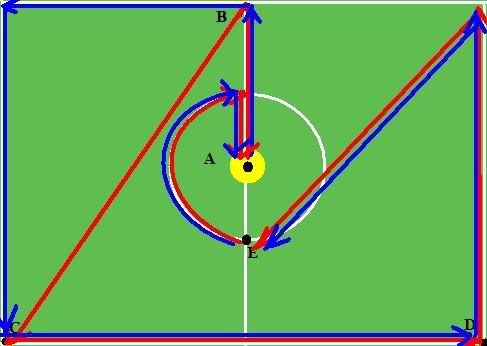
The displacement vector to get from one point to another is red. In blue, the path we have followed to reach that point.
3.

The table does not match the distance to the displacement because it would agree only if both have been taken in a straight line.
4.
These tables correspond respectively to the results obtained by taking as a reference system points B, C and D.


0 comments:
Post a Comment